Since 1 October 2026, Meta charges for the replies businesses send customers through the WhatsApp Business Platform (the API). Each business phone number gets 1,000 free service replies a month, and every reply after that is billed per message at the rate for your customer’s country. Messages customers send you are still free.
For two years, answering customers on WhatsApp cost nothing at the API level, so many businesses never budgeted for it. That changed this autumn. In this guide we explain exactly what Meta now charges for, what is still free, how to estimate your own monthly cost, and the simplest ways to keep the bill down. Everything here is based on Meta’s own pricing documentation, which we link at the end.
What changed, and when
The October change is the latest step in a series that began in 2024.
|
Date |
What happened |
|---|---|
|
1 November 2024 |
Service replies (free-form messages sent while a customer conversation is open) became free for all businesses |
|
1 July 2025 |
Meta switched from charging per conversation to charging per message. Utility templates sent during an open conversation became free |
|
1 August 2026 |
Replies written by Meta’s own AI agent, Meta Business Agent, started being charged by the amount of text the AI processes |
|
1 October 2026 |
Service replies and in-conversation utility templates became chargeable again, per message. Each business phone number gets 1,000 free service replies a month |
One practical detail caught some businesses out: if a WhatsApp account had no payment method on file, Meta delivers replies within the free 1,000 but stops delivering them after that. If your provider manages billing for you, check this has been set up.
Which messages you now pay for
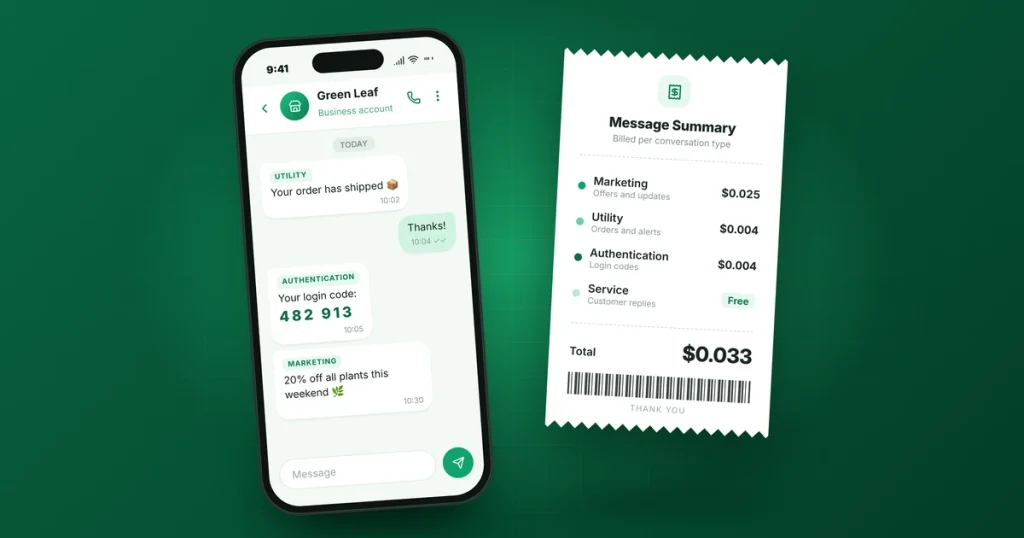
Every message a business sends falls into exactly one of five categories, and is charged once, for that category only.
|
Category |
What it’s for |
When you can send it |
Charged? |
|---|---|---|---|
|
Marketing template |
Promotions, offers, reminders to buy |
Any time, to customers who opted in |
Yes, per message |
|
Utility template |
Order confirmations, booking reminders, account updates |
Any time |
Yes, per message, including during an open conversation since October 2026 |
|
Authentication template |
One-time passcodes |
Any time |
Yes, per message |
|
Service message |
Free-form replies from your team or a third-party chatbot |
Only within 24 hours of the customer’s last message |
Yes since October 2026, after 1,000 free a month per number |
|
Meta Business Agent message |
Replies written by Meta’s AI agent |
Only within 24 hours of the customer’s last message |
Yes since August 2026, by AI usage |
Service messages are charged at the same rate as utility and authentication messages for the customer’s country. Unlike those two categories, they get no volume discount however many you send.
What is still free
- Messages customers send you. Meta only charges for messages from businesses, and only when they are delivered.
- Your first 1,000 service replies each month, per phone number. Unused replies don’t roll over; the allowance resets monthly.
- Conversations that start from a Click-to-WhatsApp ad. When a customer messages you from one of these ads on the WhatsApp mobile app and you reply in time, a free window opens that can last up to 7 days. Marketing, utility, authentication and service messages in that window are free. Meta Business Agent replies are still charged.
- The WhatsApp Business app. These changes apply to the API, which businesses use for automation, shared inboxes and CRM connections. Replying by hand in the free WhatsApp Business app on your phone isn’t billed this way.
- Eligible government and non-profit organisations. Meta has said service replies stay free beyond the 1,000 allowance for eligible organisations until 31 December 2027.
How to estimate your monthly cost
You can work out a realistic figure in about ten minutes with numbers from your WhatsApp provider’s dashboard.
- Count your monthly conversations by phone number, and note which countries your customers are in.
- Find the average number of replies your team or chatbot sends per conversation. Count each message separately: three short messages cost three times as much as one complete one.
- Multiply to get service messages per month, then subtract 1,000 for each business phone number.
- Look up the rate for each customer country on Meta’s rate card, using the utility rate (service messages use the same rate). Multiply by the billable messages.
- Add your templates: booking confirmations and reminders (utility), promotions (marketing) and passcodes (authentication).
Here’s how that works for a clinic that handles 600 WhatsApp enquiries a month, with staff sending an average of five replies to each. That’s 3,000 service messages. The first 1,000 are free, so 2,000 are billed at the rate for its patients’ country. Each appointment confirmation and reminder it sends is billed separately as a utility message.
A note for businesses in Nigeria: Nigeria has its own rate on Meta’s rate card, but the naira is not one of the 16 currencies Meta bills in. Nigerian businesses are billed in one of the supported currencies, such as US dollars, so exchange-rate movements affect the real cost.
Who will notice it most
- Small businesses replying by hand may pay nothing for service messages if they stay under 1,000 replies a month per number.
- Busy support teams with long back-and-forth conversations will see the clearest increase, because every reply now counts.
- Businesses using a third-party chatbot pay twice in effect: the AI provider charges for the AI, and Meta charges for delivering each reply as a service message.
- Businesses messaging customers abroad pay different rates per country. The US and Canada share one North America rate, while Nigeria, the UK and Spain each have their own.
Seven ways to keep the bill down
- Send one complete reply instead of several short ones. This is the biggest saving for most teams and usually reads better for the customer too.
- Use buttons and lists. Interactive options let customers choose in one tap, cutting the back-and-forth.
- Answer common questions on your website. Link to a clear page for prices, opening hours or delivery times rather than typing them out each time.
- Remove filler messages. Automatic “Thanks, we’ve received your message” replies are now charged once you pass the free allowance.
- Run campaigns through Click-to-WhatsApp ads where it makes sense, so the conversations that follow fall inside the free window.
- Compare chatbot costs properly. Meta estimates its own AI agent at about 4–5 US cents per message. A third-party chatbot means the AI provider’s fee plus the service message rate. Compare the full cost per conversation, not just the AI price.
- Check your numbers monthly. Most providers show message counts by category. Watch the trend after the first few months, and remember Meta can change rates on the first day of any quarter.
App or API: which do you need?
If one or two people answer customers by hand, the free WhatsApp Business app may be all you need, and none of the API charges apply. You need the API when you want automation, a shared inbox for several staff, or WhatsApp connected to your CRM or booking system. In that case the per-message cost is worth budgeting properly, because the time saved usually outweighs it. We’ll compare the two in detail in a separate guide.
Frequently asked questions
Are WhatsApp business replies still free?
Through the API, only the first 1,000 service replies per business phone number each month are free. Replies after that are billed per message. Replies typed in the WhatsApp Business app aren’t affected.
Do I pay for messages customers send me?
No. Meta charges only for messages sent by businesses, and only when they are delivered.
How much does a WhatsApp service message cost in Nigeria?
Service messages cost the same as utility messages for the customer’s country. Nigeria has its own rate on Meta’s rate card, so check the current rate there, as Meta can update it each quarter. Billing is in a supported currency such as US dollars, since the naira isn’t one of them.
Does the 1,000 free allowance apply to each phone number?
Yes. Each business phone number gets its own 1,000 free service replies per month, and the count resets monthly.
Can Meta change WhatsApp prices again?
Yes. Meta can update rates on 1 January, 1 April, 1 July and 1 October, with at least a month’s notice for rate changes.
Want a WhatsApp setup that costs less to run?
We can review how your business uses WhatsApp today, count where the billable messages come from, and redesign the flow so customers get answers faster with fewer messages. Find out more about our AI chat agents, workflow automation and lead management, or talk to our team.
Sources
- Meta for Developers: Pricing on the WhatsApp Business Platform (updated 30 September 2026): categories, free 1,000 service messages, free entry point window of up to 7 days, markets, currencies, pricing calendar, government and non-profit policy
- Meta for Developers: Pricing updates for Meta Business Agent, service and utility messages (updated 1 July 2026): timeline, service messages charged at the utility and authentication rate, no volume tiers, Meta Business Agent at $2 per million tokens