Published guides quote anything from a few hundred dollars to more than $30,000 for a small business website, plus running costs every year. The spread is wide because “a website” can mean a five-page template or a custom system with bookings and payments. What you pay depends on the number of page designs, custom work, features, content and who builds it.
If you’ve searched for website prices, you’ve probably found numbers that contradict each other. We think that’s the most useful place to start, because once you understand why prices vary so much, you can tell a fair quote from an unfair one. In this guide we explain what you are paying for, what pushes the price up or down, the running costs that are easy to forget, and how to compare quotes on equal terms.
Why website price guides disagree
Here is what four widely read guides say a small business website costs:
|
Guide |
What it says |
|---|---|
|
WebFX (based on 2,000+ businesses) |
$1,000 to $48,000 for a small business website; agency design $3,000 to $30,000+ |
|
WebsiteSetup |
$5,000 to $15,000 for a full-service agency build; WordPress developers around $50 to $95 an hour |
|
Elementor |
$10,000 to $35,000 for a small business website |
|
Startups.co.uk (UK) |
£300 to £1,000 for a basic site from a web designer; £10,000+ for bespoke work |
They aren’t all wrong. They’re measuring different things.
- “Website” means different things. One guide prices a five-page brochure site; another prices a site with booking, payments and a client area.
- What’s included varies. Some figures include strategy, copywriting and photography. Others assume you supply all the content.
- Location matters. Rates differ widely between countries, so a guide written for London or New York won’t match a quote from elsewhere.
- Who wrote it matters. Website builders, hosting companies and agencies all publish cost guides, and each tends to frame the numbers around what it sells.
The practical lesson: ignore any single headline figure, and compare quotes based on exactly what they include.
What you are actually paying for
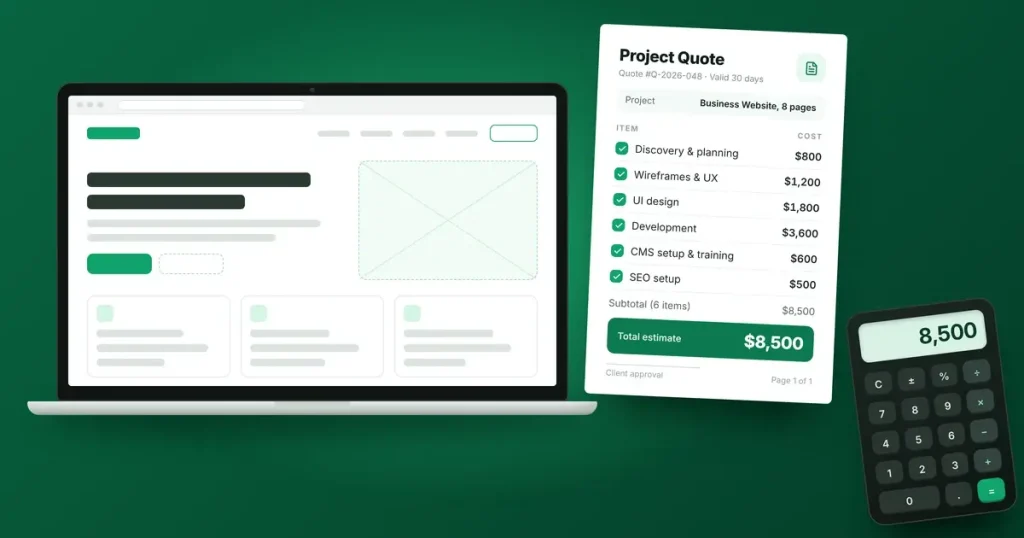
A professional website project usually includes six pieces of work. The more of them a quote covers, the higher the price, and the less you’ll have to do yourself.
- Planning: understanding your customers, deciding which pages you need and what each one should achieve.
- Design: how the site looks on phones and computers, built around your brand.
- Build: turning the design into a working site that you can update yourself.
- Content: the words, photos and graphics. This is the part businesses most often underestimate.
- Search foundations: page titles, descriptions, fast loading and a structure Google can read.
- Launch and support: testing, going live, training your team and fixing early issues.
Cost by build path
There are four common ways to get a business website. Each suits a different stage.
|
Path |
Upfront cost |
Ongoing cost |
Best for |
Watch out for |
|---|---|---|---|---|
|
Website builder (Wix, Squarespace and similar) |
Low |
Monthly plan; Wix’s entry paid plan was $17 a month billed annually in late 2026 |
Testing an idea, very small budgets |
Your time, design limits, and moving away later can be hard |
|
Freelancer |
Low to medium |
Varies by agreement |
Simple sites with a clear brief |
Everything depends on one person’s availability |
|
Agency or specialist team |
Medium to high |
Optional care plan |
Businesses that need strategy, design and support together |
Paying for more than you need |
|
Fully custom build |
High |
Higher, for specialist upkeep |
Unique features no template can handle |
Rarely needed for a standard business site |
What pushes the price up or down
- Number of unique page designs. Twenty service pages that share one layout cost far less than twenty pages each designed differently.
- Custom design or a template. A template is cheaper and faster; custom design fits your brand and customers more closely.
- Content. Writing, photography and video add cost, but they also decide whether visitors trust you.
- Features. Online booking, payments, a members’ area, multiple languages, or a connection to your CRM all add build time.
- Moving an old site. Transferring content and redirecting old links so you don’t lose search traffic takes careful work.
- Speed and accessibility standards. Meeting higher standards takes more testing.
- Decision-making. More people signing off, and more rounds of changes, add time.
- Deadlines. A rushed launch usually costs more.
The running costs most quotes leave out
The build is only part of the cost. Every website also has yearly costs, and these are the ones to ask about.
- Domain name: typically around $12 to $25 a year.
- Hosting: shared hosting often costs $3 to $15 a month; managed WordPress hosting, which handles more of the technical upkeep, is commonly $60 to $250 a year for a small business.
- Licences: premium themes, plugins and booking or form tools often charge yearly.
- Maintenance: software updates, security checks, backups and fixes, either your own time or a care plan.
- Content updates: new pages, offers and photos as the business changes.
To compare options fairly, work out a three-year total cost:
Build cost + 3 × (domain + hosting + licences + maintenance) + planned content updates
A cheap build with expensive monthly fees can cost more over three years than a higher upfront price with low running costs.
How to compare two quotes
Before you choose, check that both quotes answer the same questions:
- Which pages are included, and how many unique designs?
- Who writes the content and supplies photos?
- How many rounds of changes are included?
- Are search foundations, speed work and analytics setup included?
- Who owns the domain, hosting account, design files and content? (It should be you.)
- What support is included after launch, and for how long?
- What is the timeline, and what is the payment schedule?
- Will you be trained to update the site yourself?
Red flags in a website quote
- A single price with no list of what’s included
- The domain registered in the supplier’s name, not yours
- A closed platform you can’t move away from without starting again
- No mention of phones, speed or search basics
- Promises of “guaranteed first place on Google”
- Full payment upfront for a large project, with no milestones
- Nothing said about what happens after launch
How we price at Dura Networks
We quote a fixed price for every website, based on the scope we agree with you, and we send the proposal within one business day. You own your domain, site, accounts and data. If you’d like to see what’s included in a typical project, have a look at our business websites page.
Frequently asked questions
How much does a basic business website cost?
It depends on who builds it and where. A few pages built on a website builder can cost little upfront plus a monthly plan, while a professionally designed small site from a freelancer or agency usually costs more upfront but less of your time. Compare quotes by what they include, not the headline number.
Is a website builder cheaper in the long run?
Not always. Builders have low upfront costs but monthly fees that continue for as long as the site exists, and your own time has a cost too. Work out the three-year total for each option.
What yearly costs should I budget for?
Plan for a domain name, hosting, any software licences, maintenance and content updates. Ask every supplier to list these separately.
Why do quotes for the same website vary so much?
Usually because they don’t cover the same work. One may include planning, content and support; another may only cover the build. Put quotes side by side using the checklist above.
Should I pay for a website upfront?
For larger projects, staged payments tied to milestones, such as design approval and launch, protect both sides. Be cautious of any supplier asking for the full amount before work starts.
Get a clear, fixed price
Tell us what you need and we’ll reply within one business day with a recommendation and a fixed-price proposal. Explore our website development services, see how we look after sites with website care and managed hosting, or get a quote.
Sources
- WebFX: How Much Does a Website Cost? and How Much Does It Cost to Build a Website for a Small Business?
- WebsiteSetup: Small Business Website Costs (agency range, developer rates, domain and hosting costs)
- Elementor: How Much Does a Small Business Website Cost?
- Startups.co.uk: How much does a website cost for a small business? (UK figures, updated March 2026)
- Hostinger: How Much Does It Cost to Build a Website for a Small Business (shared hosting range)
- Expert Market: Wix Pricing (Wix Light plan, $17 a month billed annually)