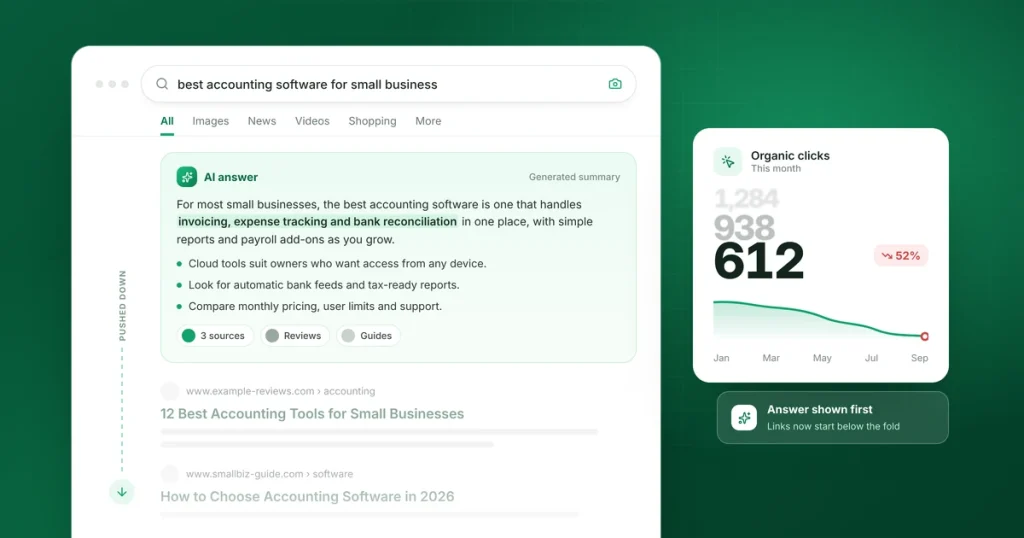
Yes, AI Overviews reduce the clicks websites get from Google. The strongest 2026 evidence puts the drop at roughly a third to more than half on searches where an AI Overview appears, depending on how it is measured and where you rank. Brand, local and ready-to-buy searches are holding up better than general questions.
If your Search Console shows impressions holding steady while clicks fall, this is probably part of the reason. Plenty of articles quote one dramatic number. We read the main studies instead, and in this guide we explain what each one measured, why their results differ, which of your searches are most affected, and how to check your own data.
What the 2026 research actually measured
Six studies matter most. They use different methods, so their numbers are not directly comparable, but they all point the same way.
|
Study |
Who and when |
Method |
Main finding |
|---|---|---|---|
|
Pew Research Center |
900 US adults, March 2025 |
Browsing data shared by participants |
People clicked a regular result on 8% of visits when an AI summary appeared, against 15% without one. Links inside the summary were clicked on 1% of visits |
|
Ahrefs |
300,000 keywords, December 2023 vs December 2025 |
Aggregated Search Console data, desktop |
Where an AI Overview appeared, click-through for the top result was about 58% lower than expected. Even position 10 fell by about 19% |
|
SparkToro with Similarweb |
US Google searches, January to April 2026 |
Clickstream panel |
68% of searches ended without a click, up from 60% in 2024 |
|
Agarwal and Sen (Indian School of Business, Carnegie Mellon University) |
1,065 US desktop Chrome users, January to February 2026 |
Randomised experiment: AI Overviews hidden for one group |
38% fewer organic clicks on searches that showed an AI Overview. Searches ending with no click rose from 54% to 72% |
|
Wang and colleagues (University of Pennsylvania, Northeastern University) |
1,100 US users, March 2026 |
Preregistered randomised experiment |
Sending every search to AI Mode cut clicks to other websites by 18.8 percentage points. Hiding AI Overviews raised them by 8.8 points |
|
Seer Interactive |
53 brands, 2.43 billion impressions, January 2025 to February 2026 |
Client Search Console data |
Click-through on AI Overview searches recovered from 1.3% to 2.4% in early 2026, still below searches without one |
The two experiments carry the most weight. Because people were randomly assigned to see AI features or not, any difference between the groups comes from the AI features themselves, not from seasonality or algorithm updates. Both are working papers that have not yet been through peer review, so treat their exact figures as provisional.
Why the numbers don’t match
A 38% drop, a 58% drop and an 18.8-point drop sound contradictory. They aren’t, because each study answers a slightly different question.
- They measure different things. SparkToro measures the share of all searches that end without any click. Ahrefs measures click-through for a given ranking position. The experiments measure how often the same people click when AI features are switched on or off.
- Correlation is not cause. Pew, Ahrefs and SparkToro observe what happened while many things changed at once. The experiments isolate the AI effect, which is why their figures are smaller but more reliable.
- AI Overviews and AI Mode are different products. AI Overviews sit on top of normal results. AI Mode is a separate, conversational way of searching. In SparkToro’s data, only 0.34% of searches moved into AI Mode between January and April 2026, although Google said at its I/O conference in 2026 that AI Mode had passed one billion monthly users. The AI Mode experiment forced every search into it, so it shows a worst case, not today’s typical behaviour.
- Position matters. Agarwal and Sen found the effect came almost entirely from AI Overviews shown at the top of the page, which was where they appeared 85% of the time.
- The samples are narrow. Most of this research looks at US searchers, often on desktop, over a few weeks. No comparable study has been published for most other markets, so the size of the effect elsewhere is still unmeasured.
The fair summary: on searches where an AI Overview appears at the top, expect substantially fewer clicks, and plan as if that is permanent rather than a dip that will correct itself.
Which of your searches are most exposed
Not every search triggers an AI Overview, and the pattern is fairly predictable.
- Questions and long searches. Pew found that 60% of searches starting with who, what, when or why produced an AI summary, as did 53% of searches of ten words or more. Only 8% of one- or two-word searches did.
- Informational intent. Seer’s April 2026 data showed AI Overviews on 36% of informational queries, against 8% of commercial and 5% of transactional ones.
- Searches that still send clicks. SparkToro’s co-founder Rand Fishkin points to branded searches, local business searches and high-intent searches where someone is ready to buy as categories where SEO still pays off well.
For a typical business, this means a blog post answering “what is X” is far more exposed than your service pages, pricing page, booking page or contact page. That is not a reason to stop publishing helpful content. It is a reason to judge each page by what it is meant to do.
How to check your own Search Console
Search Console doesn’t report AI Overview clicks separately, so you have to read the pattern. This takes about 30 minutes.
- Compare periods. In Performance › Search results, use Compare to set the last three months against the same three months a year earlier. Turn on clicks, impressions, average CTR and average position.
- Look for the tell-tale pattern. In the Queries tab, sort by impressions. Queries with steady or rising impressions, a similar position and a falling CTR are the ones most likely affected by AI Overviews.
- Separate brand from non-brand. Add a query filter using Custom (regex) with your brand name and its common misspellings, then view “Doesn’t match”. Non-brand questions usually show the largest drops.
- Check the results page yourself. Search your top affected queries in a private browser window. Note whether an AI Overview appears and whether your site is cited in it.
- Find the pages behind the drop. In the Pages tab, see whether the losses sit on informational articles or on service and product pages. These need different responses.
- Follow the money, not just the traffic. In Google Analytics, check enquiries or sales by landing page. Fewer clicks on an explainer article may not mean fewer customers, if your service pages are holding up.
What to do about it
Put more weight on searches that still earn clicks
Pages that offer something a summary can’t give are your safest ground: prices, quotes, cost calculators, booking, original data, and detailed comparisons of providers. In the AI Mode experiment, one of the most common complaints was that it was hard to reach specific websites. People still want to visit a business when they are ready to act, so make sure your service and contact pages are fast, clear and easy to find.
Earn a place inside the answer
AI Overviews draw on pages Google can crawl and index, so the technical basics still apply. Beyond that, answer the main question clearly near the top of the page, use descriptive headings, add structured data where it fits, and keep your business facts consistent across your site and the directories that describe you. Being mentioned and cited elsewhere helps too. None of this guarantees a citation, but it improves your chances. Our AI search optimisation work and our page on Google AI Overviews explain the approach in more detail.
Measure visibility and clicks separately
If a page is cited in an AI answer but gets fewer clicks, it may still be influencing buyers. Track four things side by side: impressions, a small set of important queries where you check whether you are cited, visits from AI assistants such as ChatGPT and Perplexity in Google Analytics, and enquiries. Blending them into one “traffic” number hides what is really changing.
Keep the foundations in good shape
A slow, hard-to-crawl site is less likely to be shown anywhere, in AI answers or in regular results. If you haven’t checked your site’s technical SEO recently, that is still the first job.
The counter-evidence
Not every 2026 study is gloomy. Seer Interactive found that click-through on AI Overview searches climbed from a low of 1.3% in December 2025 to 2.4% in February 2026, while searches without an AI Overview improved from 2.8% to 3.8% over a longer period. Seer itself warns against forecasting a recovery from two months of data and describes it as levelling off at a lower base.
Google argues that the clicks AI Overviews still send are higher quality, with fewer people bouncing straight back. It has not published independent data to support that, and the Agarwal and Sen experiment found no measurable improvement in how satisfied people were with their searches. The honest position is that the direction is clear and the size is still moving.
We covered the bigger picture of answer engines in an earlier article, How AI Search Is Reshaping the Future of SEO.
Frequently asked questions
Do AI Overviews reduce website traffic?
On searches where they appear, yes. Randomised experiments in 2026 found clear drops in clicks to websites, and observational studies found larger ones. Searches without an AI Overview are much less affected.
Is AI Mode worse for traffic than AI Overviews?
In the one experiment that tested it, sending every search to AI Mode reduced clicks more than AI Overviews did. Very few searches used AI Mode in early 2026, so its real-world effect depends on how quickly people adopt it.
Can I see AI Overview clicks in Search Console?
Not separately. They are counted within your normal web search figures. The practical method is to look for queries with steady impressions and falling click-through, then check those results pages yourself.
Does this apply to businesses outside the US?
Most of the research is US-based, so the exact figures may not transfer. Where AI Overviews are shown, the direction is likely to be similar. Your own Search Console data is the best guide for your market.
Not sure what's happening to your traffic?
If your clicks are falling and you want to know why, we can look at your Search Console data with you and show which searches and pages are affected, and what is worth doing about it. Talk to our team.
Sources
- Pew Research Center: Google users are less likely to click on links when an AI summary appears in the results (July 2025)
- Ahrefs: Update: AI Overviews Reduce Clicks by 58% (February 2026)
- Search Engine Land: Google zero-click searches hit 68% in early 2026 (SparkToro and Similarweb data)
- Search Engine Journal: Study Confirms Google AI Overviews Cut Organic Clicks 38% (April 2026), covering Agarwal and Sen’s working paper on SSRN
- Wang, Gleason, Bart, Wilson and Metaxa: AI in Search Reduces Publisher Referrals Without Improving User Experience (arXiv preprint, August 2026), summarised by Relevant Audience
- Seer Interactive: AIO Impact on Google CTR, 2026 Update (April 2026)